
Technology
Why Most Websites Never Rank: The 7 SEO Mistakes That Quietly Kill Traffic
Most websites today are built like beautiful homes…but without roads leading to them.They stand quietly on the internet, waiting but no footsteps arrive. SEO isn’t magic.It’s architecture.Structure.Signals that speak to search engines in a language they understand. In my work with businesses of all sizes clinics, photographers, coaches
Dhanesh M7 min read
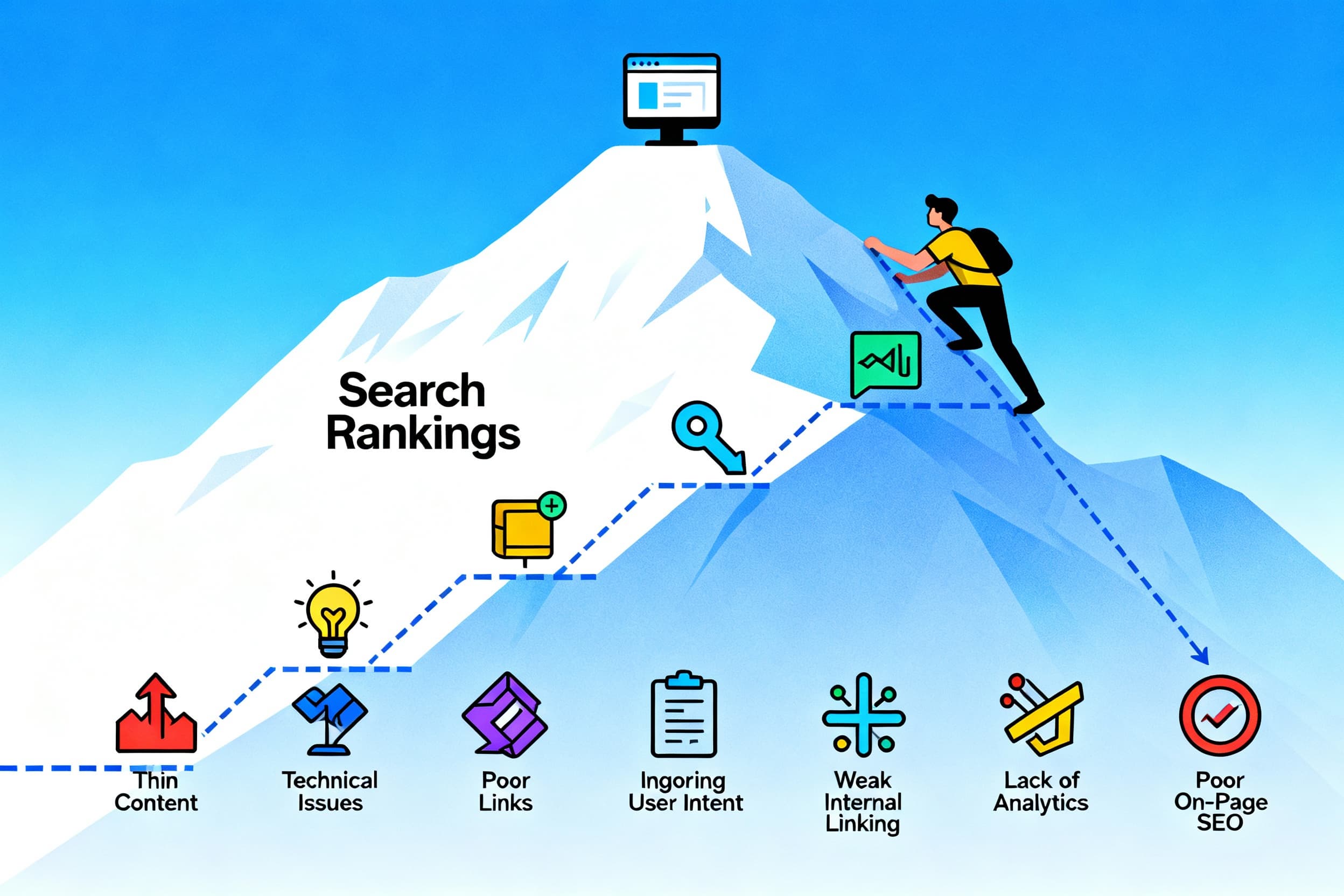
Building a website is only half the battle. The real challenge begins when you try to get people to find it. Every day, thousands of new pages go live on the web—but only a small fraction ever appear on the first page of Google. The rest get buried in the noise, never seen by their intended audience.
Why does this happen? Most websites don’t fail because their business ideas are bad or their design looks outdated. They fail because of preventable SEO mistakes that quietly suffocate their visibility.
This article breaks down the seven most common SEO pitfalls that silently kill traffic—and shows how to fix them for sustainable, long-term growth.
1. Ignoring Search Intent
One of the biggest killers of organic traffic is ignoring what users are actually looking for. Keyword research alone isn’t enough anymore. Modern SEO revolves around understanding search intentthe “why” behind every search query.
There are four main types of search intent:
Informational – The user wants to learn something. Example: “What is on-page SEO?”
Navigational – The user wants to visit a specific site. Example: “Moz blog”
Transactional – The user is ready to buy. Example: “Buy best SEO tool”
Commercial investigation – The user is comparing options. Example: “Ahrefs vs Semrush review”
Many websites target keywords without understanding where those keywords fit. For instance, writing a long blog post for a transactional query means you’re missing out on a buyer audience. Conversely, writing a product page for an informational query fails because users aren’t ready to purchase yet.
How to fix it: Before creating content, analyze the top-ranking pages for your keyword. Are they guides, product pages, comparisons, or tools? Match your format and content angle to the dominant search intent.
2. Thin or Low-Value Content
Google’s algorithms have evolved to reward helpful, substantial content. Yet, many websites still publish short, surface-level articles stuffed with keywords, hoping to rank quickly. This outdated approach no longer works.
Thin content doesn’t provide enough value to satisfy readers or search engines. If users land on your page but leave within seconds because they didn’t get what they wanted, it signals to Google that your page isn’t useful.
How to fix it:
Aim for depth, not just length. Thoroughly cover a topic from multiple angles.
Incorporate real-world examples, expert quotes, or case studies.
Use internal linking to connect related ideas and keep users exploring your site.
Regularly audit old posts. If some pages bring little traffic and offer little value, merge or rewrite them instead of keeping them as dead weight.
Comprehensive, well-researched content not only helps users but also earns backlinks naturally—something Google still values highly.
3. Neglecting Technical SEO
You can have the best content in the world, but if your technical foundation is weak, search engines may never find or properly index your pages. Technical SEO is the invisible structure that helps search bots crawl, interpret, and rank your site efficiently.
Common mistakes include:
Missing or incorrect meta tags
Poor site architecture with broken or duplicate URLs
Slow page loading speed
No XML sitemap or robots.txt errors
Unoptimized mobile experience
Google uses a mobile-first index, which means your mobile version—not desktop—determines most ranking signals. If your website isn’t mobile-friendly or loads slowly, it’s already at a disadvantage.
How to fix it:
Use Google Search Console to identify crawl errors and indexing issues.
Run Core Web Vitals reports to fix speed and performance bottlenecks.
Ensure canonical tags are properly set to avoid duplicate content.
Implement structured data (schema) to help search engines understand your content.
Regular technical audits, even quarterly, can prevent small issues from snowballing into ranking drops.
4. Poor On-Page Optimization
On-page SEO is where many websites lose easy opportunities to rank. It’s not just about adding keywords; it’s about creating context that both readers and search engines can understand.
Common on-page mistakes include:
Generic or missing title tags and meta descriptions
Unoptimized headings and subheadings
Keyword stuffing or inconsistent keyword placement
Ignoring image alt text and filenames
These are small technical details, but collectively, they affect how your page ranks and how users click through from search results.
How to fix it:
Craft unique, keyword-focused title tags that capture search intent.
Add meta descriptions that encourage clicks with a clear value proposition.
Use headings (H1–H3) logically to structure your content hierarchy.
Optimize images with descriptive names and alt text for accessibility and SEO.
Remember, search engines crawl pages like readers skim articles—they pay attention to clarity, structure, and relevance.
5. Weak Internal Linking and Site Architecture
Most site owners focus heavily on backlinks (external links) but neglect internal linking—which is equally important. Internal links help search engines understand relationships between pages and distribute authority across your website.
A poorly linked site confuses both crawlers and users. If search engines can’t reach certain pages through internal links, those pages might never get indexed.
How to fix it:
Build topic clusters. Create a main “pillar” page for each key topic, then link supporting pages to it.
Use descriptive anchor text instead of generic words like “click here.”
Add links from high-authority pages to newer, less-visited posts.
Ensure every important page is reachable within three clicks from your homepage.
Good internal linking reduces crawl depth, improves engagement, and signals topical relevance—all ranking factors Google values.
6. Forgetting About Backlinks or Quality Signals
No matter how much SEO changes, backlinks remain one of the strongest ranking factors. The problem is most businesses either ignore link-building entirely or pursue it the wrong way—by buying spammy links or using low-quality directories.
Google’s algorithm looks for trust, authority, and relevance when evaluating backlinks. A few contextual, high-quality links from credible websites can outweigh hundreds of random backlinks from unrelated sources.
How to fix it:
Earn links naturally through exceptional content such as original research, case studies, or visual guides.
Build relationships with other creators, bloggers, and journalists in your niche.
Use outreach campaigns to pitch guest posts or collaborations.
Regularly review your backlink profile using tools like Ahrefs or Google Search Console to disavow harmful links.
When you focus on quality over quantity, your backlinks become long-term trust signals that steadily lift your ranking.
7. Not Monitoring Analytics or SEO Performance
The final and perhaps most destructive mistake is flying blind—publishing content, running campaigns, and never checking what’s actually working.
SEO isn’t a one-time effort; it’s a cycle of testing, measuring, and adjusting. Without data, you can’t know whether your content aligns with audience demand or which strategies deliver ROI.
How to fix it:
Track key metrics: organic sessions, impressions, average position, CTR, and bounce rate.
Use Google Analytics to monitor engagement and conversions.
Review Google Search Console for queries driving traffic and underperforming pages.
Set precise KPIs, such as improving existing rankings or doubling traffic to specific categories.
Regular analytics reviews keep your strategy grounded in facts, not assumptions. The best-performing SEO campaigns evolve continually, guided by reliable data.
Beyond Fixes: Building an SEO Culture
SEO success isn’t just about checklists—it’s about mindset. Many teams see SEO as a technical chore rather than a guiding principle of their online growth. The companies that dominate search results often treat SEO as a long-term investment rooted in content excellence and user experience.
A strong SEO culture means:
Educating every content creator about keyword intent and structure.
Collaborating between developers, designers, and marketers on site performance.
Treating analytics as a feedback loop, not an afterthought.
Consistently aligning SEO goals with business goals—traffic should convert, not just impress.
When SEO becomes part of your company’s DNA, improvements compound over time—every new page, feature, or campaign benefits from the same disciplined approach.
The Takeaway
Most websites don’t rank because they fail quietly—not through big mistakes, but through small, consistent neglect. Ignoring user intent. Publishing weak content. Letting technical errors pile up. Forgetting to measure results.
But the good news is that SEO is forgiving—once you correct these fundamentals, you can recover lost visibility and regain momentum. The moment you start aligning technical health, genuine content value, and user-centered strategy, Google begins to reward your effort.
In the long run, SEO isn’t about gaming the algorithm—it’s about building trust. The websites that rank best are the ones that deliver the most value, consistently, to real human readers. Fix these seven silent mistakes, and your site won’t just rank—it will earn its place there.
Topics
- seo
- website ranking
- seo mistakes
- seo tips
- search engine optimization
- traffic growth
- content marketing
- digital marketing
- seo audit
- on-page seo
- technical seo
- backlinks
- internal linking
- search intent
- meta tags
Get the next post by email
About twice a month. Nothing else.